
Working with intelligent people can be exhilarating. They see patterns others miss, solve difficult problems, challenge conventional thinking, and push organizations beyond what previously appeared possible.
But intelligence alone does not make someone a leader.
Intelligence is a capability. Character determines how that capability is used.
A highly intelligent person can use knowledge to illuminate the truth or conceal it. They can use their command of a subject to develop others or diminish them. They can challenge an organization’s assumptions or protect their own status. The more capable the person, the greater the consequences of the character directing that capability.
This is why the “Toxic High Performer” is not merely a cultural inconvenience. It is a leadership failure.
Such individuals may produce results. They may close deals, write exceptional code, solve complicated problems, or consistently outperform their peers. Because their contributions are measurable, leaders frequently rationalize the damage they cause. Colleagues are expected to tolerate the arrogance, intimidation, credit-taking, belittlement, or refusal to accept accountability because the individual is considered too valuable to lose.
But the cost does not disappear simply because it is not immediately reflected on a financial statement.
People stop speaking honestly. Junior employees withhold unfinished ideas. Colleagues spend more time managing personalities than solving problems. Strong performers leave. Weak decisions go unchallenged because challenging them carries personal risk. The organization becomes less intelligent because one intelligent person has made everyone else afraid to think out loud.
People may comply with a Toxic High Performer. They will rarely give that person their trust, loyalty, creativity, or discretionary effort.
The better standard is not intelligence alone. It is intelligence governed by kindness and humility.
Kindness does not mean lowering standards or avoiding difficult conversations. Real kindness tells people the truth while there is still time to act on it. It corrects without humiliating, listens without immediately judging, and holds people accountable without denying their dignity. Kindness is not weakness. It is strength exercised with an awareness of its effect on others.
Humility is equally misunderstood. It is not insecurity, passivity, or pretending to know less than you do. Humility is the confidence to recognize that no matter how much you know, you may still be wrong. It allows a leader to say, “I do not know,” “I made the wrong decision,” or “Your idea is better than mine” without feeling that authority has been surrendered.
Humility places truth above ego.
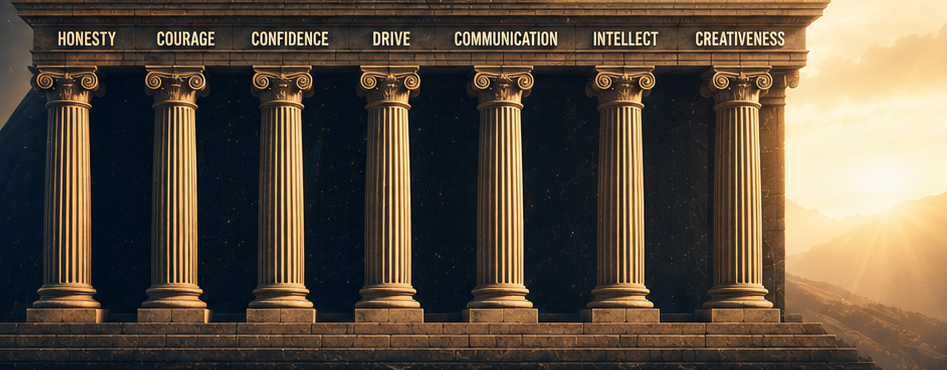
These qualities govern each of the Seven Pillars of leadership.
Honesty without kindness can become cruelty, while kindness without honesty becomes avoidance. Courage is required to confront toxic conduct, particularly when the person responsible is powerful or productive. Confidence allows leaders to stand firmly without needing to dominate. Drive advances the mission without treating people as expendable. Communication creates understanding through listening as well as speaking. Intellect provides the ability to comprehend complexity, but humility keeps that intellect curious and correctable. Creativeness flourishes when people feel safe enough to offer incomplete ideas, take reasonable risks, and learn from failure.
Kindness and humility are therefore not alternatives to strong leadership. They are disciplines governing how leadership’s strength is used.
Organizations reveal their true values not only through the behavior they reward, but through the behavior they excuse. A company may publicly celebrate respect, integrity, and collaboration, but when it repeatedly protects a toxic high performer, it communicates a different standard: results matter more than character.
That decision eventually affects the quality of the results themselves.
The most effective teams are not composed merely of smart people. They are composed of capable people who can pursue truth without making every disagreement personal, exercise authority without making others feel small, and achieve difficult objectives without destroying the trust required for the next objective.
Intelligence may earn someone a place in the room. Character determines what happens to the room once they enter it.
The best leaders do not need to prove that they are the smartest person present. They use their intelligence to make the entire organization wiser. They do not use confidence to elevate themselves above others. They use it to create stability for others. They do not use drive to demand sacrifice from everyone around them. They use it to sustain a shared mission.
Smart people can build impressive organizations.
Smart people governed by honesty, courage, confidence, drive, communication, intellect, creativeness, kindness, and humility can build institutions worthy of enduring.